
Nitrile vs Vinyl Gloves: Cost, Protection & Best Uses (2026)
Nitrile vs vinyl gloves — the short answer
Choose nitrile gloves for anything beyond low-risk: automotive, chemical handling, clinical work, greasy or longer food tasks, and any job where a reliable, puncture- and chemical-resistant barrier matters. Choose vinyl gloves only when the task is genuinely low-risk — short-duration, non-hazardous, high-turnover work like light food prep and quick cleanups — where the lowest cost per glove wins. Want some of nitrile's durability at a lower price? A nitrile-vinyl blend is the middle-ground step-up.
Shopping for vinyl specifically? See our best vinyl gloves buyer’s guide and browse the full vinyl gloves collection.
Reviewed by Steven Eaton, WC Safety Editorial. Last updated June 22, 2026.
Sources: manufacturer specifications (AMMEX, MED PRIDE, Schneider), ASTM D6319 standard for nitrile examination gloves, ASTM D5250 for vinyl examination gloves, FDA 21 CFR 177 food-contact criteria, EN 374 chemical-protection standard, and OSHA 29 CFR 1910.138. Editorial standard: zero sponsored listings, independently selected, built for industrial buyers.
Nitrile vs vinyl gloves comes down to a single trade-off: protection versus price. Nitrile is the stronger, more chemical- and puncture-resistant glove with a more reliable barrier, while vinyl is the cheapest disposable option that performs fine for low-risk, short tasks. This guide compares nitrile and vinyl gloves head-to-head on cost, protection, food use and durability, then tells you exactly which to buy for your work. If you also want to weigh latex in the mix, start with our nitrile vs latex vs vinyl reference or the how to choose disposable gloves guide, and for the full category overview see our complete nitrile gloves buyer's guide.
Editorial verdict: for most buyers, choose nitrile gloves — the stronger, more chemical- and puncture-resistant glove with the more reliable barrier. Pick vinyl gloves only for genuinely low-risk, short, non-hazardous tasks where the lowest cost wins. The AMMEX 3 Mil Food-Safe Nitrile is a strong all-round nitrile pick; the Schneider Blue Vinyl is the low-risk budget option.
VIEW ON WC SAFETY → CHECK PRICE ON AMAZON →
As an Amazon Associate, WC Safety earns from qualifying purchases. Prices and availability are accurate as of the date shown and are subject to change. Full affiliate disclosure.
Nitrile vs vinyl gloves at a glance
| Dimension | Nitrile gloves | Vinyl gloves |
|---|---|---|
| Material | Acrylonitrile-butadiene synthetic rubber | Polyvinyl chloride (PVC) with plasticizers |
| Durability / puncture | High — resists tears and punctures | Low — punctures and tears easily |
| Chemical resistance | Strong vs oils, fuels, many solvents | Weak — for incidental contact only |
| Barrier reliability (AQL) | Tight AQL on exam grade; reliable seal | Looser fit, higher pinhole/leak rate |
| Fit and feel | Form-fitting, elastic, good dexterity | Loose, less elastic, baggy fit |
| Latex-free / allergy | Yes — latex-free, low accelerator options | Yes — latex-free, accelerator-free |
| Cost | Moderate | Lowest per box |
| Best use | Beyond-low-risk: auto, chemical, clinical, food | Low-risk, short tasks: light food prep, cleanups |
As an Amazon Associate, WC Safety earns from qualifying purchases. Prices and availability are accurate as of the date shown and are subject to change. Full affiliate disclosure.
When to choose nitrile gloves
Choose nitrile gloves whenever the task rises above low-risk: handling oils, fuels or chemicals; automotive and mechanical work; clinical and lab contact; and greasy or extended food tasks. Nitrile's stretch-to-fit feel, puncture resistance and tighter barrier make it the right default for the large majority of buyers. Here are three stocked nitrile picks that span food-safe, general-purpose and budget needs.
AMMEX Nitrile Gloves, 3 Mil — best food-safe all-rounder
Material: nitrile · Thickness: 3 mil · Food-safe (FDA 21 CFR 177) · Powder-free, latex-free
For food work and general handling where vinyl would tear or degrade on fats, the AMMEX 3 Mil Food-Safe Nitrile delivers nitrile's durability and reliable barrier in a light, dexterous gauge. It is the obvious upgrade from vinyl for any kitchen that handles oils or runs longer shifts. See it on the AMMEX 3 Mil Food-Safe Nitrile product page.
→ Browse the best nitrile gloves for food service guide
Pros
- Food-safe under FDA 21 CFR 177
- Nitrile durability vs vinyl on oils and fats
- Light 3 mil keeps dexterity for prep
Cons
- 3 mil is not heavy-duty for shop abuse
- Sold as a case, larger upfront buy
VIEW ON WC SAFETY →CHECK PRICE ON AMAZON →
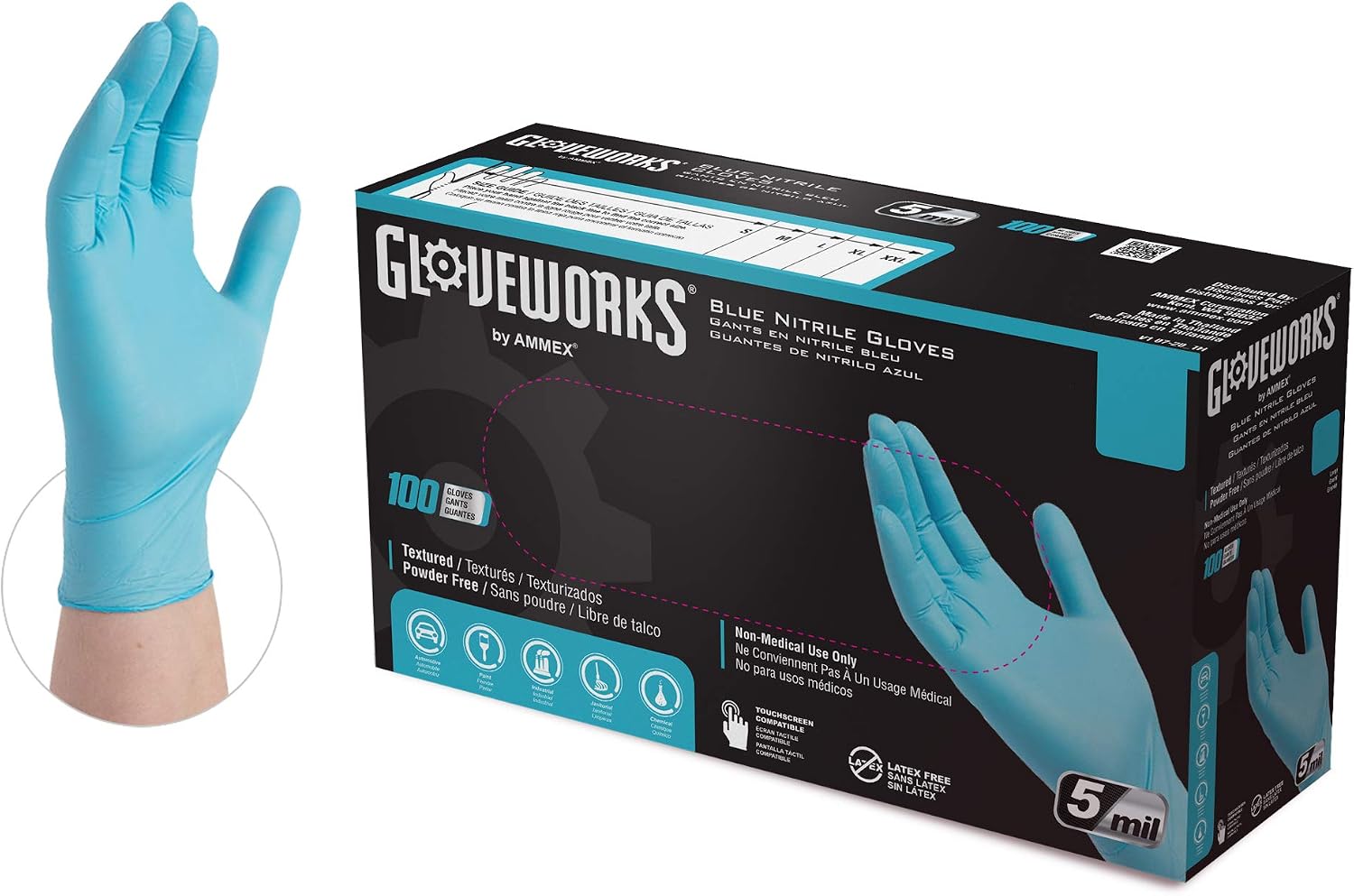
GLOVEWORKS Blue Nitrile Industrial, 5 Mil — best general-purpose nitrile
Material: nitrile · Thickness: 5 mil · Food-safe · Powder-free, latex-free
When you need a single nitrile glove that covers shop, cleanup and food-contact duty, the GLOVEWORKS Blue Nitrile Industrial 5 Mil is the workhorse. At 5 mil it has real puncture and chemical-splash resistance vinyl can't match, with the elastic fit that makes nitrile comfortable for long wear. See it on the GLOVEWORKS Blue Nitrile product page.
→ Read our full GLOVEWORKS Blue Nitrile Industrial review · Browse the nitrile gloves collection
Pros
- 5 mil balances protection and dexterity
- Food-safe and chemical-splash resistant
- Trusted AMMEX quality control
Cons
- Costs more per box than vinyl
- Not maximum gauge for heavy automotive abuse
VIEW ON WC SAFETY →CHECK PRICE ON AMAZON →
AMMEX SwiftGrip Black Nitrile — best budget nitrile step-up from vinyl
Material: nitrile · Thickness: ~5 mil · Grip texture · Powder-free, latex-free
If cost is what pulls you toward vinyl, the AMMEX SwiftGrip Black Nitrile is the lowest-priced way to get true nitrile protection. You gain puncture resistance, a grip texture and a more reliable barrier over vinyl while keeping the box price low — the right pick when you want nitrile without a premium. See it on the AMMEX SwiftGrip product page.
→ Read our full AMMEX SwiftGrip Black Nitrile review · Browse the nitrile gloves collection
Pros
- Lowest-priced real nitrile here
- Grip texture and nitrile puncture resistance
- Latex-free, powder-free
Cons
- Thinner build than heavy industrial nitrile
- Not for sharp-metal automotive abuse
VIEW ON WC SAFETY →CHECK PRICE ON AMAZON →
When vinyl gloves are enough
Vinyl earns its place on one axis: cost. For genuinely low-risk, short-duration, non-hazardous work — light food prep, sandwich assembly, quick wipe-downs, brief contact tasks with frequent glove changes — vinyl gloves deliver an acceptable barrier at the lowest price per glove. They are not the choice for chemicals, oils, puncture hazards or extended wear, but for high-turnover low-risk tasks they keep costs down. Here are the two stocked vinyl picks.
Schneider Blue Vinyl Exam Gloves — best low-risk budget pick
Material: vinyl (PVC) · Exam grade · Powder-free, latex-free
The Schneider Blue Vinyl Exam Gloves are the economical choice for short, low-risk tasks where you change gloves often and don't need chemical or puncture protection. The blue color helps spot a torn fragment in food settings. For anything greasy or longer, step up to nitrile. See it on the Schneider Blue Vinyl product page.
→ Browse the vinyl gloves collection
Pros
- Lowest cost per box
- Latex-free, powder-free, exam grade
- Blue color aids fragment detection in food prep
Cons
- Weak chemical and puncture resistance
- Looser fit, higher pinhole rate than nitrile
- Not for oils, solvents or extended wear
VIEW ON WC SAFETY →CHECK PRICE ON AMAZON →
Schneider Clear Vinyl Exam Gloves — best for brief, light-contact tasks
Material: vinyl (PVC) · Exam grade · Powder-free, latex-free
The Schneider Clear Vinyl Exam Gloves cover the same low-risk, high-turnover use as the blue version in a clear film — brief food handling, light assembly and quick non-hazardous tasks at the lowest price. Treat them as a barrier for water and light, non-hazardous substances only. See it on the Schneider Clear Vinyl product page.
→ Browse the vinyl gloves collection
Pros
- Cheapest disposable option
- Latex-free, powder-free, exam grade
- Fine for brief low-risk handling
Cons
- Minimal chemical and puncture resistance
- Loose fit, less dexterity than nitrile
- Breaks down quickly on fats and oils
VIEW ON WC SAFETY →CHECK PRICE ON AMAZON →
The middle ground: nitrile-vinyl blend
Material: nitrile-vinyl blend · Exam grade · Powder-free, latex-free
If straight vinyl feels too flimsy but full nitrile costs more than your task justifies, the MED PRIDE Nitrile Vinyl Blend Exam Gloves are the budget step-up. The blend adds some of nitrile's stretch and tear resistance to vinyl's lower cost, making it a sensible middle ground for moderate-risk, cost-sensitive work that sits between the two. See it on the MED PRIDE Nitrile Vinyl Blend product page.
→ Browse the nitrile gloves collection
Pros
- Cheaper than full nitrile
- More durable and elastic than straight vinyl
- Latex-free, powder-free middle ground
Cons
- Not as protective as full nitrile
- Still weaker than nitrile on chemicals
- Best only for moderate-risk tasks
VIEW ON WC SAFETY →CHECK PRICE ON AMAZON →
Nitrile vs vinyl gloves: cost
Cost is vinyl's one clear win. Vinyl is consistently the cheapest disposable glove per box, which is why high-volume, low-risk operations reach for it — the Schneider Blue Vinyl and Schneider Clear Vinyl sit at the bottom of the price range. Nitrile costs more per glove, but the gap narrows with budget nitrile like the AMMEX SwiftGrip, and nitrile's longer wear life and lower failure rate can offset the higher box price on tasks where a torn glove means a redo. If your work is low-risk and high-turnover, vinyl's cost advantage is real; otherwise, nitrile's value holds up.
Nitrile vs vinyl gloves: protection
Protection is nitrile's decisive win. Nitrile resists punctures, tears, oils, fuels and many solvents far better than vinyl, and exam-grade nitrile is held to a tighter AQL (acceptable quality level) for barrier integrity, meaning fewer pinholes and leaks. Vinyl's looser fit and weaker PVC film give it a higher failure rate and only minimal chemical resistance — appropriate for water and light, non-hazardous substances, not for hazards. For any chemical, puncture or contamination exposure, choose nitrile; for prolonged chemical contact, choose a nitrile glove rated to EN 374 with a published breakthrough chart. Cut hazards are a separate question — neither disposable replaces ANSI/ISEA 105 cut-rated gloves.
Nitrile vs vinyl gloves: food use
Both materials appear in food service, and many vinyl and nitrile exam gloves are food-contact compliant under FDA 21 CFR 177. Vinyl is acceptable for short, low-risk handling such as light prep and assembly, where its cost and easy changes shine. But vinyl breaks down faster on fats and oils and tears more readily, so for greasy foods, longer shifts or anything where a barrier failure matters, food-safe nitrile like the AMMEX 3 Mil Food-Safe Nitrile is the more reliable choice. Our best nitrile gloves for food service guide covers the food-grade options in depth.
Nitrile vs vinyl gloves: durability and fit
Nitrile is the more durable and better-fitting glove. Its synthetic rubber stretches to the hand for a form-fitting, dexterous feel and resists tearing under stress, while vinyl is looser, less elastic and more prone to splitting at the seams and developing pinholes — especially when stretched or exposed to oils. That difference makes nitrile better for extended wear and tasks that stress the glove, and limits vinyl to short-duration use with frequent changes. For a heavier nitrile feel, browse our best black nitrile gloves guide or the full nitrile gloves collection.
What are nitrile and vinyl gloves?
Nitrile gloves are disposable gloves made from acrylonitrile-butadiene rubber, a synthetic, latex-free polymer that stretches to fit and resists oils, fuels and many chemicals. Vinyl gloves are made from polyvinyl chloride (PVC) with plasticizers; they are also latex-free but looser, less elastic and offer a weaker chemical and puncture barrier. Both avoid the latex allergy risk of natural rubber. The defining difference is performance versus price: nitrile protects better and fits better, vinyl costs less. For how these two compare against latex as a third option, see our nitrile vs latex vs vinyl reference and how to choose disposable gloves guide.
Which gloves should you buy?
Match the glove to the risk. For automotive, mechanical and chemical work, buy nitrile — vinyl tears and degrades. For clinical, lab and contamination-control tasks, buy exam-grade nitrile for its tighter barrier. For greasy or longer food tasks, buy food-safe nitrile like the AMMEX 3 Mil Food-Safe Nitrile. For low-risk, short, high-turnover work — light food prep, quick cleanups — vinyl like the Schneider Blue Vinyl keeps cost down. For a budget compromise, the MED PRIDE Nitrile Vinyl Blend sits in between. When in doubt, choose nitrile — it covers more situations safely. Browse all options in our hand protection collection.
Related nitrile gloves guides
Part of WC Safety's complete nitrile gloves guide. Keep exploring:
Best-of buyer’s guides
- Best black nitrile gloves
- Best nitrile exam gloves
- Best nitrile gloves for food service
- Best nitrile gloves for mechanics
- Best heavy-duty nitrile gloves
- Best chemical-resistant nitrile gloves
- Best nitrile gloves for cleaning
- Best accelerator-free nitrile gloves
- Best orange nitrile gloves
- Best purple nitrile gloves
Comparisons
Reference & explainers
Nitrile vs vinyl gloves: frequently asked questions
Are nitrile gloves better than vinyl gloves?
For most uses, yes. Nitrile gloves are stronger, far more puncture- and chemical-resistant, and seal more reliably than vinyl, which is why they win for automotive, chemical, clinical and most food work. Vinyl gloves only win on pure cost for low-risk, short-duration, non-hazardous tasks. For the full breakdown across three materials, see our nitrile vs latex vs vinyl reference.
What is the difference between nitrile and vinyl gloves?
Nitrile is a synthetic rubber that stretches to fit the hand and resists oils, fuels and many chemicals; vinyl is PVC plastic that is looser, less elastic and offers a weaker chemical and puncture barrier. The practical result: nitrile protects better, vinyl costs less. See the at-a-glance table above for a side-by-side.
Are vinyl gloves cheaper than nitrile gloves?
Yes — vinyl is typically the cheapest disposable glove, which is its main advantage. The Schneider Blue Vinyl and Schneider Clear Vinyl are the budget picks here. If you go through high volumes on low-risk tasks, vinyl lowers your cost per glove.
Are vinyl gloves safe for food?
Vinyl is acceptable for short, low-risk food handling such as light prep and assembly, and many vinyl exam gloves are food-contact compliant. But vinyl breaks down faster with fats and oils, so for greasy or longer food tasks, choose food-safe nitrile like the AMMEX 3 Mil Food-Safe Nitrile. See our best nitrile gloves for food service guide.
Which gloves are better for mechanics and automotive work?
Nitrile, decisively. Vinyl tears on fasteners and degrades on oils and fuels, while nitrile resists both. For shop work choose a heavier nitrile such as the GLOVEWORKS Blue Nitrile or a black industrial glove from our best black nitrile gloves guide. Vinyl is not appropriate for automotive use.
Do nitrile or vinyl gloves protect against chemicals?
Nitrile resists many oils, greases, fuels and common solvents; vinyl offers only minimal, incidental chemical resistance. For any chemical exposure beyond a brief splash you want nitrile, and for prolonged contact a glove rated to EN 374 with a breakthrough chart. Vinyl should be treated as a barrier for water and light, non-hazardous substances only.
Are nitrile and vinyl gloves latex-free?
Yes — both nitrile and vinyl are synthetic and contain zero natural latex protein, so both are safe for people with latex allergies. If you are switching specifically to avoid latex, our how to choose disposable gloves guide walks through nitrile, latex and vinyl side by side.
When should I choose vinyl gloves over nitrile?
Choose vinyl when the task is genuinely low-risk: short-duration, non-hazardous, high-turnover work like light food prep, quick cleanups, or brief contact tasks where cost and frequent glove changes matter more than barrier strength. For anything beyond low-risk, step up to nitrile.
Is there a glove that splits the difference between nitrile and vinyl?
Yes — a nitrile-vinyl blend like the MED PRIDE Nitrile Vinyl Blend is the budget step-up. It adds some of nitrile's stretch and durability over straight vinyl while staying cheaper than full nitrile, making it a sensible middle ground for moderate-risk, cost-sensitive work.
Are vinyl gloves stronger than nitrile gloves?
No. Nitrile is significantly stronger, more elastic and more puncture-resistant than vinyl. Vinyl tends to tear, split at the seams and develop pinholes more readily, especially under stress or with oils. If durability matters, nitrile is the better choice.
How long can you wear vinyl gloves compared to nitrile?
Vinyl is designed for short-duration use and tends to loosen, tear or break down faster, so it suits quick tasks with frequent changes. Nitrile holds its barrier longer and fits more securely, making it better for extended wear. Match the glove to how long the barrier must last.
Do vinyl gloves have a higher failure or pinhole rate than nitrile?
Generally yes. Vinyl's looser fit and weaker film typically produce a higher pinhole and leak rate than exam-grade nitrile, which is held to a tighter AQL (acceptable quality level) for barrier integrity. For tasks where a reliable barrier matters, nitrile is the safer pick.
Which gloves should I buy for cleaning and janitorial work?
For light, short cleanups with mild substances, vinyl is an economical choice. For cleaning with stronger chemicals, greasy messes, or longer sessions, nitrile resists the chemicals and lasts longer — a nitrile glove from our complete nitrile gloves guide is the more reliable option.
Do nitrile or vinyl gloves meet OSHA hand-protection requirements?
Neither is mandated by name. OSHA 29 CFR 1910.138 requires employers to select hand protection from a documented hazard assessment. For chemical-splash, contamination or light-abrasion hazards, a correctly chosen nitrile glove satisfies the standard; vinyl is only appropriate where the assessment confirms the hazard is low-risk.
How this nitrile vs vinyl gloves comparison was researched. Recommendations were drawn from gloves reviewed on WC Safety and evaluated against primary sources: (1) manufacturer specifications and box documentation (AMMEX/GLOVEWORKS, MED PRIDE, Schneider); (2) ASTM D6319 for nitrile examination gloves and ASTM D5250 for vinyl examination gloves; (3) FDA 21 CFR 177 food-contact criteria; (4) EN 374 chemical-protection criteria; and (5) OSHA 29 CFR 1910.138 hand-protection requirements. No first-person wear testing is claimed; conclusions reflect specification and use-case analysis.
Disclosure. WC Safety is a participant in the Amazon Services LLC Associates Program, an affiliate advertising program; as an Amazon Associate we earn from qualifying purchases via links on this page (tag wcsafety04-20). We accept no payment for placement — listings are independently selected. Prices and availability are accurate as of the date shown and subject to change. This guide is general information, not medical, legal or safety-compliance advice; verify glove suitability against your own hazard assessment.
Primary sources for this page
The wording behind this page sits in OSHA 29 CFR 1910.138, OSHA 29 CFR 1910.132, NIOSH Personal Protective Equipment.
Why trust this page?
Why trust this page? Every figure on it is taken from the published text of the standard or the manufacturer document named beside it, not from a secondary summary. WC Safety is an independent PPE review site: we hold no inventory and sell nothing directly, so there is no product we need this page to favour. Where sources disagree, the page says so and plans on the more conservative figure rather than picking one.
Methodology: how this page is maintained
Methodology. Figures are read from the primary source and re-checked whenever the underlying standard or a manufacturer document changes. No laboratory testing is performed for this page. Where a figure is not published, the page states that rather than estimating it, because a plausible invented number is more dangerous than an absent one.
Leave a comment