
Nitrile-Coated vs PU-Coated Work Gloves: Which Grip Wins? (2026)
Nitrile-coated vs PU-coated work gloves — the short answer
Choose a nitrile coating for oily, greasy and abrasive work — it grips slick parts (foam nitrile especially) and outlasts thinner coatings — and choose a PU (polyurethane) coating for dry precision, where its thin palm delivers the best touch sensitivity at the lowest cost. Top nitrile picks: the Ansell HyFlex 11-840 Foam Nitrile and MCR Safety 92785NFS Micro-Foam Nitrile A5. Top PU picks: the MCR Safety 92752S A5 PU and Ansell HyFlex 11-727 PU.
Reviewed by Steven Eaton, WC Safety Editorial. Last updated June 22, 2026.
Sources: ANSI/ISEA 105 cut-resistance standard and manufacturer specifications (Ansell, MCR Safety, PIP, Ergodyne). Editorial standard: zero sponsored listings, independently selected, built for industrial buyers.
The nitrile coated vs PU coated gloves question comes down to one thing: what is on the surface you are gripping. Both are palm coatings applied over the same kind of cut-resistant knit shell — the coating is not the glove material, it is the grip-and-protection layer dipped onto the palm. A nitrile coating is the best glove coating for oil, abrasion and durability, with foam-nitrile variants engineered for wet and oily grip. A PU (polyurethane) coating is the thinnest option, prized for dry dexterity, touch sensitivity and lower cost, at the price of weaker oil resistance. This guide lays out the honest trade-offs and names the specific stocked gloves to buy for each. For the full category background, start with our complete cut-resistant gloves guide.
Editorial verdict — nitrile coated vs PU coated gloves: for most buyers facing any oil, grease or heavy abrasion, a nitrile coating is the safer all-rounder — foam nitrile for wet/oily grip and longer abrasion life. Choose a PU coating only when the work is dry and precision and fingertip feel (or the lowest cost) matter most. Our default nitrile pick is the Ansell HyFlex 11-840 Foam Nitrile; our default PU pick is the Ansell HyFlex 11-727 PU.
VIEW ON WC SAFETY → CHECK PRICE ON AMAZON →
As an Amazon Associate, WC Safety earns from qualifying purchases. Prices and availability are accurate as of the date shown and are subject to change. Full affiliate disclosure.
Nitrile coating vs PU coating: at a glance
How the two coatings compare across the dimensions that decide most purchases. This is about the palm coating only — cut level is set by the knit shell, not the dip.
| Dimension | Nitrile coating | PU (polyurethane) coating |
|---|---|---|
| Oil / grease resistance | Excellent — nitrile shrugs off oil, fuel and grease; foam nitrile grips wet/oily parts | Poor — smooth PU loses grip on oil; not for greasy work |
| Dexterity / touch sensitivity | Good, but coating is thicker; foam adds bulk | Best in class — thinnest coating, highest fingertip feel |
| Abrasion resistance / durability | Higher — nitrile palm survives rough, abrasive surfaces longer | Lower — thin PU wears through faster on abrasive work |
| Grip on rough/oily surfaces | Strong, especially foam-nitrile texture in oil | Strong on dry parts only; slips once oil is present |
| Cost | Higher per pair | Lower — cheapest coated gloves to stock |
| Best use | Automotive, metal fab, oily assembly, heavy abrasion | Dry precision, electronics, inspection, light assembly, warehouse |
As an Amazon Associate, WC Safety earns from qualifying purchases. Prices and availability are accurate as of the date shown and are subject to change. Full affiliate disclosure.
When to choose a nitrile coating
Reach for a nitrile coating whenever oil, grease, fuel or heavy abrasion is in play. Nitrile is a synthetic rubber that resists oils and survives rough surfaces, and foam-nitrile palms actively grip wet and oily parts that would slide out of a smooth coating. It is the best glove coating for automotive, metal fabrication, machining and oily parts handling. Browse the full cut-resistant gloves collection or pick from the nitrile-coated gloves below.
MCR Safety 92785NFS CutPro A5 Micro-Foam Nitrile
Coating: micro-foam nitrile · Cut level: ANSI A5 · Best for: wet/oily grip with cut protection
A micro-foam nitrile coating over an A5 cut-resistant shell, this MCR Safety glove is purpose-built for the wet and oily grip that foam nitrile does best. The foam structure wicks surface oil away from the contact patch, so the palm bites into greasy parts instead of slipping. It pairs heavy cut protection with the abrasion durability nitrile is known for. See it on the MCR Safety 92785NFS CutPro A5 Micro-Foam Nitrile product page.
→ Browse the cut-resistant gloves collection
Pros
- Foam nitrile excels at wet and oily grip
- ANSI A5 cut protection built in
- Strong abrasion and oil resistance
Cons
- Thicker coating than PU dips
- Less bare-finger touch sensitivity
VIEW ON WC SAFETY →CHECK PRICE ON AMAZON →
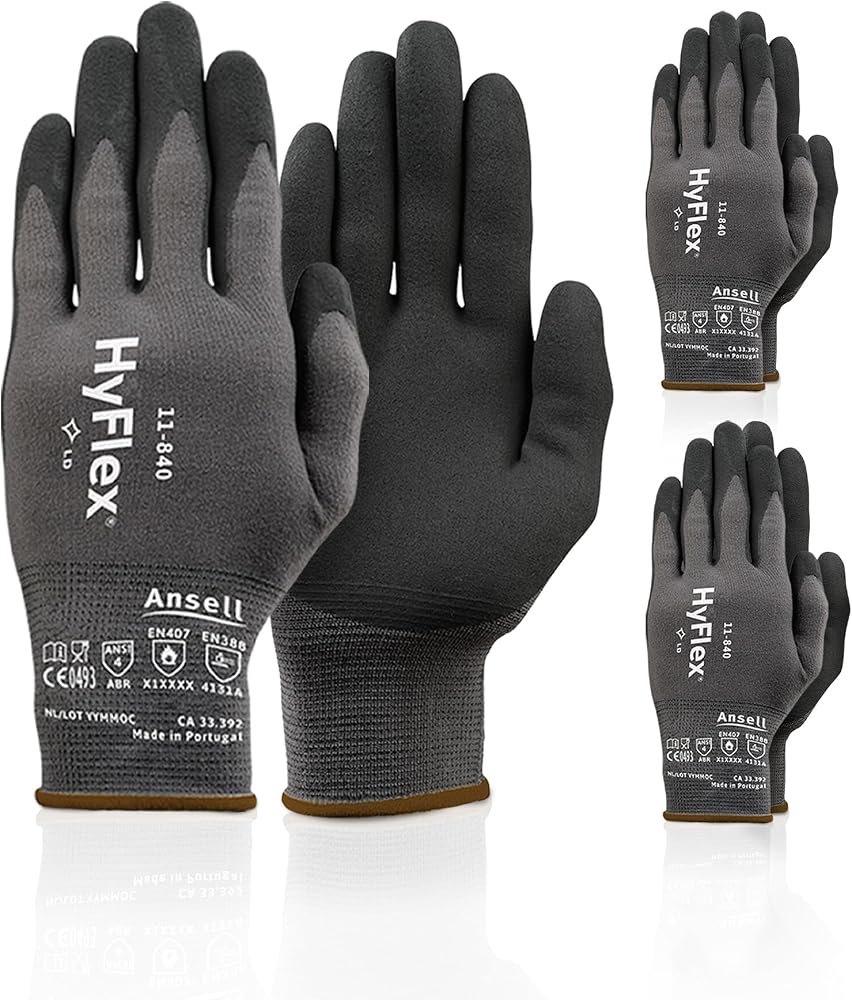
Ansell HyFlex 11-840 Foam Nitrile
Coating: foam nitrile · Cut level: abrasion-rated · Best for: oily/dry general handling
The Ansell HyFlex 11-840 is the reference-standard foam nitrile coating for high-dexterity general handling. Its foam-nitrile palm grips equally well on dry and lightly oily surfaces and resists abrasion through long shifts, while the thin knit liner keeps the glove flexible. It is the go-to when you want nitrile oil resistance without sacrificing fit. See it on the Ansell HyFlex 11-840 Foam Nitrile product page.
→ Browse the cut-resistant gloves collection
Pros
- Industry-benchmark foam nitrile grip
- Grips dry and lightly oiled parts
- High abrasion durability for the price
Cons
- Abrasion-rated, not a high cut level
- Coating bulkier than a PU palm
VIEW ON WC SAFETY →CHECK PRICE ON AMAZON →
PIP MaxiFlex Cut 34-8743 ANSI A2 Nitrile-Coated
Coating: micro-foam nitrile · Cut level: ANSI A2 · Best for: fine handling with oil resistance
PIP MaxiFlex Cut applies a patented micro-foam nitrile coating so thin it reads almost like a PU dip, yet keeps nitrile oil resistance and abrasion life. The 18-gauge liner and breathable palm make it one of the most dexterous nitrile-coated gloves available, with A2 cut protection for light-edge tasks. It is the best pick when you want nitrile durability in a precision-feeling glove. See it on the PIP MaxiFlex Cut 34-8743 ANSI A2 Nitrile-Coated product page.
→ Browse the cut-resistant gloves collection
Pros
- Thinnest, most dexterous nitrile coating
- Micro-foam grips light oil well
- Breathable 18-gauge liner
Cons
- Only ANSI A2 cut level
- Light coating wears faster than thick nitrile
VIEW ON WC SAFETY →CHECK PRICE ON AMAZON →
Ergodyne ProFlex 7070 ANSI A7 Nitrile-Coated
Coating: nitrile · Cut level: ANSI A7 · Best for: heavy abrasion and high cut hazard
When the hazard is both heavy abrasion and a high cut level, the Ergodyne ProFlex 7070 puts a durable nitrile coating over an A7 shell. The nitrile palm resists oil, fuel and rough-surface wear far better than a thin PU dip would, making it the durability and oil-resistance end of the coating spectrum for demanding metal and glass handling. See it on the Ergodyne ProFlex 7070 ANSI A7 Nitrile-Coated product page.
→ Browse the cut-resistant gloves collection
Pros
- ANSI A7 cut protection
- Nitrile palm survives heavy abrasion
- Strong oil and fuel resistance
Cons
- Heavier and less dextrous than PU
- Higher price per pair
VIEW ON WC SAFETY →CHECK PRICE ON AMAZON →
When to choose a PU (polyurethane) coating
Reach for a PU coating when the work is dry and dexterity is the priority. Polyurethane dips are the thinnest palm coatings made, so they preserve the most fingertip feel for fine assembly, electronics, inspection and warehouse handling — and they are the cheapest coated gloves to stock. The trade-off is oil resistance: a smooth PU palm slips once grease appears. Browse the broader hand protection collection or pick from the PU-coated gloves below.
MCR Safety 92752S CutPro A5 PU-Coated
Coating: polyurethane · Cut level: ANSI A5 · Best for: dry precision with cut protection
A thin polyurethane palm over an A5 shell, the MCR Safety 92752S is the dry-precision answer to the foam-nitrile 92785NFS above. The smooth PU coating is the thinnest in this guide, giving the highest touch sensitivity and fingertip feel for fine assembly while still carrying A5 cut protection. It is the pick when dexterity matters more than oil resistance. See it on the MCR Safety 92752S CutPro A5 PU-Coated product page.
→ Browse the hand protection collection
Pros
- Thinnest coating for top dexterity
- ANSI A5 cut protection
- Lower cost than coated nitrile equivalent
Cons
- PU offers little oil resistance
- Smooth palm slips on wet/oily parts
VIEW ON WC SAFETY →CHECK PRICE ON AMAZON →
Ergodyne ProFlex 7030 PU-Coated
Coating: polyurethane · Cut level: ANSI A3 · Best for: dry handling on a budget
The Ergodyne ProFlex 7030 is the value PU coating pick — a thin polyurethane palm on a 13-gauge A3 liner that keeps fingertip feel high and cost low. PU dips like this are the cheapest coated gloves to stock, so they suit dry electronics, warehouse and inspection work where there is no oil to defeat the grip. See it on the Ergodyne ProFlex 7030 PU-Coated product page.
→ Browse the hand protection collection
Pros
- Lowest-cost coated option here
- High dexterity for dry tasks
- Light, breathable 13-gauge build
Cons
- No meaningful oil or solvent resistance
- ANSI A3, lower than the A5/A7 picks
VIEW ON WC SAFETY →CHECK PRICE ON AMAZON →
Ansell HyFlex 11-727 PU-Coated
Coating: polyurethane · Cut level: abrasion/cut-rated · Best for: all-day dry dexterity
The Ansell HyFlex 11-727 pairs a nylon/spandex liner with a thin polyurethane palm for all-day comfort and touch. The PU coating keeps the glove light and low-profile so workers actually keep them on, making it a strong choice for precision dry handling, light assembly and inspection where breathability and feel win out over oil resistance. See it on the Ansell HyFlex 11-727 PU-Coated product page.
→ Browse the hand protection collection
Pros
- Light, breathable PU palm
- Excellent dry dexterity and feel
- Comfortable for all-day wear
Cons
- PU palm is not for oily work
- Lower abrasion life than nitrile
VIEW ON WC SAFETY →CHECK PRICE ON AMAZON →
MCR Safety 9277PUS CutPro A7 Hi-Vis PU
Coating: polyurethane · Cut level: ANSI A7 · Best for: high cut hazard with dry precision
Proof that PU is not only a budget coating, the MCR Safety 9277PUS puts a hi-vis PU coating over an A7 shell — high cut protection with the thin-palm dexterity PU is prized for. It is the pick when you need to handle sharp glass or sheet metal precisely in dry conditions and want to be seen doing it. See it on the MCR Safety 9277PUS CutPro A7 Hi-Vis PU product page.
→ Browse the hand protection collection
Pros
- ANSI A7 cut protection
- Thin PU palm keeps high dexterity
- Hi-vis color for visibility
Cons
- PU palm slips on oil and grease
- Dry-only grip strength
VIEW ON WC SAFETY →CHECK PRICE ON AMAZON →
Head-to-head: grip
On dry surfaces both coatings grip well, and the thin PU palm can feel slightly more connected to the part. The decisive difference is wet and oily grip: a foam-nitrile coating channels oil away from the contact patch and keeps biting, while a smooth PU coating loses traction as soon as oil is present. If your parts are ever slick, nitrile — especially foam nitrile like the MCR Safety 92785NFS Micro-Foam Nitrile — wins the grip contest. CHECK PRICE ON AMAZON →
Head-to-head: oil and chemical resistance
This is the most lopsided category. Nitrile resists oils, greases and fuels by chemistry; polyurethane does not. A nitrile coating keeps grip and structural integrity around petroleum products, which is why it dominates shop and industrial work. A PU coating is fine for clean dry handling but should not be relied on around oil or solvents. For high-cut oily work, the Ergodyne ProFlex 7070 A7 Nitrile is the durable choice. CHECK PRICE ON AMAZON →
Head-to-head: dexterity and touch sensitivity
Here PU takes the win. Because a PU coating is the thinnest dip available, it gives the highest fingertip feel for fine, repetitive, dry tasks — assembly, electronics, inspection. A nitrile coating is slightly thicker, and foam nitrile adds a little bulk in exchange for oil grip. Micro-foam nitrile such as the PIP MaxiFlex Cut 34-8743 narrows the gap, reading almost like a PU dip while keeping nitrile oil resistance. For pure dry precision, the MCR Safety 92752S A5 PU is the feel leader. CHECK PRICE ON AMAZON →
Head-to-head: durability and abrasion
A nitrile coating outlasts a PU coating on abrasive work — metal edges, brick, concrete and rough castings wear through a thin PU palm faster than a tougher nitrile palm. If gloves are getting chewed up on abrasive surfaces, switching to nitrile lowers replacement frequency. On clean, dry, low-abrasion tasks, PU lasts perfectly well at lower cost, which is why it stays popular for warehouse and inspection roles.
Head-to-head: cost
PU wins on price. Polyurethane-dipped gloves are typically the cheapest coated gloves to buy and stock, like the Ergodyne ProFlex 7030 PU, making them the default for high-volume dry handling. A nitrile coating costs more per pair but earns it back through oil grip and abrasion life on demanding jobs — so the true cost depends on how fast a cheaper PU glove would wear out in your conditions. CHECK PRICE ON AMAZON →
What are nitrile and PU coatings? Coating vs glove material
A coated work glove is a knit shell — the part that sets the ANSI/ISEA 105 cut level — with a polymer dipped onto the palm and fingers for grip and protection. The coating is not the glove material; it is the grip layer. A nitrile coating is a synthetic rubber dip that resists oil and abrasion, available smooth or as textured foam nitrile for wet grip. A PU coating is a thin polyurethane dip prized for dexterity and low cost in dry conditions. You choose the shell for the cut hazard and the coating for the surface conditions — the two decisions are independent.
Which coating to buy for your work
Automotive, mechanic and oily parts handling
Nitrile, ideally foam nitrile, for grip on greasy parts. See the MCR Safety 92785NFS Micro-Foam Nitrile A5 and our best cut-resistant gloves for mechanics guide. CHECK PRICE ON AMAZON →
Metal fabrication and heavy abrasion
Nitrile for abrasion life, at the cut level your hazard demands — the Ergodyne ProFlex 7070 A7 Nitrile. CHECK PRICE ON AMAZON →
Electronics, assembly and inspection
PU for the thinnest, most sensitive palm — the Ansell HyFlex 11-727 PU. CHECK PRICE ON AMAZON →
High cut hazard, dry conditions
PU can deliver high cut protection with dexterity — the MCR Safety 9277PUS A7 Hi-Vis PU — or step to an A5 cut-resistant glove in either coating. CHECK PRICE ON AMAZON →
Budget, dry, high-volume handling
PU for the lowest stocking cost — the Ergodyne ProFlex 7030 PU. CHECK PRICE ON AMAZON →
Mixed or uncertain conditions
Default to nitrile as the safer all-rounder — the Ansell HyFlex 11-840 Foam Nitrile. For impact-prone work, also review ANSI/ISEA 138 impact-resistant gloves and the impact-resistant gloves collection. CHECK PRICE ON AMAZON →
Related glove comparisons and guides
Still narrowing your choice? Compare ANSI A4 vs A5 cut-resistant gloves, read cut-resistant vs impact-resistant gloves, or see the best cut-resistant gloves and best Ansell HyFlex gloves round-ups. For heat exposure, the heat-resistant gloves collection and material-handling gloves collection cover adjacent needs. OSHA hand-protection selection is covered in OSHA 29 CFR 1910.138.
Nitrile coated vs PU coated gloves: frequently asked questions
Nitrile-coated vs PU-coated gloves — which grip wins?
It depends on the surface. Nitrile coating wins on oily, greasy and rough surfaces — foam nitrile actually grips better as oil appears — while PU coating wins on dry surfaces where its thin palm gives the best fingertip feel. For oily automotive and metal work choose nitrile; for dry precision and assembly choose PU. See our cut-resistant gloves guide for the full picture.
Is nitrile coating or PU coating better for oil resistance?
Nitrile, by a wide margin. Nitrile is a synthetic rubber that resists oils, fuels and greases, so a nitrile-coated palm keeps its grip when parts are slick. Polyurethane has little oil resistance and a smooth PU palm will slip once oil is present. For any oily task, pick a nitrile-coated glove like the Ansell HyFlex 11-840 Foam Nitrile.
Which coating gives better dexterity and touch sensitivity?
PU coating. Polyurethane dips are the thinnest palm coatings available, so they preserve the most fingertip feel for fine assembly, electronics and inspection. The MCR Safety 92752S A5 PU and Ansell HyFlex 11-727 PU are the dexterity picks here. Nitrile coatings are slightly thicker, trading a little feel for durability and oil grip.
Which coating is more durable and abrasion-resistant?
Nitrile. A nitrile palm survives rough, abrasive surfaces — metal edges, brick, concrete — longer than a thin PU dip, which wears through faster. If abrasion life is the priority, a nitrile-coated glove like the Ergodyne ProFlex 7070 A7 Nitrile outlasts a comparable PU glove.
What is foam nitrile coating and when should I use it?
Foam nitrile is a textured nitrile coating with tiny air pockets that channel oil away from the contact patch, so the palm bites into wet and oily parts. Use it for greasy automotive, machining and parts handling where a smooth coating would slip. The MCR Safety 92785NFS Micro-Foam Nitrile A5 is built for exactly this.
Is PU coating cheaper than nitrile coating?
Generally yes. PU-dipped gloves are typically the lowest-cost coated gloves to stock, which is part of why they dominate dry warehouse, electronics and inspection work. The Ergodyne ProFlex 7030 PU is the budget pick. Nitrile-coated gloves cost more but earn it back in oil grip and abrasion life on demanding jobs.
Does the coating affect cut resistance?
No — cut resistance comes from the glove's knit shell (the yarn, such as HPPE or steel/glass-fiber blends), not the palm coating. Both nitrile and PU coatings are sold across the full ANSI/ISEA 105 cut levels A1 through A9. The coating affects grip, oil resistance and durability; the shell sets the cut level.
Can I use a PU-coated glove for oily or greasy work?
Not effectively. A smooth PU palm loses grip the moment oil or grease is present, so oily parts become slippery and harder to control. For wet or oily tasks switch to a nitrile-coated glove — ideally a foam-nitrile palm. Reserve PU for dry handling. Browse the cut-resistant gloves collection for both coatings.
Which coating is best for automotive and mechanic work?
Nitrile coating, specifically foam nitrile, because shop work means oil, fuel and grease. Foam-nitrile palms grip slick parts that would slide out of a PU glove. See our best cut-resistant gloves for mechanics guide for matched picks, and choose a glove like the MCR Safety 92785NFS Micro-Foam Nitrile.
Which coating is best for electronics, assembly and inspection?
PU coating. Dry, fine-handling tasks reward the thin PU palm's touch sensitivity and the lower cost of high-volume PU gloves. The Ansell HyFlex 11-727 PU and MCR Safety 92752S A5 PU are strong precision picks where no oil is involved.
Are nitrile-coated gloves breathable?
Foam-nitrile coatings are more breathable than fully-coated nitrile because the foam structure and partial palm dip let some air through, but a thin PU palm on an open knit is generally the most breathable for all-day dry comfort. If heat buildup is a concern in dry work, PU has a slight edge; in oily work nitrile is still the right call.
Nitrile coating vs PU coating — which lasts longer?
Nitrile, on abrasive and oily work, because the palm resists both wear and oil degradation. On clean, dry, low-abrasion tasks a PU glove can last perfectly well at lower cost. Match the coating to the job: nitrile for abuse and oil, PU for dry precision. Our how to choose cut-resistant gloves by ANSI level guide walks through the trade-offs.
Do both coatings come with high cut protection?
Yes. You can get either coating across the cut range — for example an A7 nitrile glove (Ergodyne ProFlex 7070) or an A7 PU glove (MCR Safety 9277PUS Hi-Vis PU). Pick the cut level for your hazard, then pick the coating for your surface conditions.
Which coating should I choose if I am not sure?
If your work is dry and precise, default to PU for feel and cost. If there is any oil, grease or heavy abrasion, default to nitrile — foam nitrile if grip on slick surfaces matters. When in doubt across mixed conditions, nitrile is the safer all-rounder. For impact-prone work also review ANSI/ISEA 138 impact-resistant gloves.
Is a coated glove the same as a disposable nitrile glove?
No. A coated work glove is a reusable knit glove with a nitrile or PU palm dip for grip and protection. A disposable nitrile glove is a thin single-use barrier glove. They solve different problems — see our nitrile gloves complete guide for the disposable side.
How this comparison was researched. Picks were selected from gloves reviewed on WC Safety and evaluated against the ANSI/ISEA 105 cut-resistance standard and manufacturer specifications (Ansell, MCR Safety, PIP, Ergodyne). Coating behavior — nitrile oil/abrasion resistance, foam-nitrile wet grip, and PU dexterity/cost trade-offs — reflects the material properties of nitrile rubber and polyurethane and each glove's published specification. No first-person wear testing is claimed; the comparison reflects specification and use-case analysis.
Disclosure. WC Safety is a participant in the Amazon Services LLC Associates Program, an affiliate advertising program; as an Amazon Associate we earn from qualifying purchases via links on this page (tag wcsafety04-20). We accept no payment for placement — listings are independently selected. Prices and availability are accurate as of the date shown and subject to change. This guide is general information, not safety-compliance advice; verify glove suitability against your own hazard assessment.
Primary sources for this page
The wording behind this page sits in OSHA 29 CFR 1910.138, OSHA 29 CFR 1910.132, NIOSH Personal Protective Equipment.
Why trust this page?
Why trust this page? Every figure on it is taken from the published text of the standard or the manufacturer document named beside it, not from a secondary summary. WC Safety is an independent PPE review site: we hold no inventory and sell nothing directly, so there is no product we need this page to favour. Where sources disagree, the page says so and plans on the more conservative figure rather than picking one.
Methodology: how this page is maintained
Methodology. Figures are read from the primary source and re-checked whenever the underlying standard or a manufacturer document changes. No laboratory testing is performed for this page. Where a figure is not published, the page states that rather than estimating it, because a plausible invented number is more dangerous than an absent one.
Leave a comment