
Cut-Resistant vs Impact-Resistant Gloves: What's the Difference? (2026)
Cut-resistant vs impact-resistant gloves — the short answer
Choose cut-resistant gloves when the hazard is blade and edge laceration — glass, sheet metal, knives, assembly — like the Ansell HyFlex 11-561 (A3). Choose impact-resistant gloves when the hazard is blunt force and struck-by — demolition, heavy equipment, pipe work — like the Mechanix Wear M-Pact. When both risks are present, a combo glove such as the HexArmor Chrome SLT 4073 does both. They protect different parts of the hand against different things.
Reviewed by Steven Eaton, WC Safety Editorial. Last updated June 22, 2026. Sources: ANSI/ISEA 105 (cut resistance, levels A1–A9), ANSI/ISEA 138-2019 (back-of-hand impact, levels 1–3), and manufacturer specifications (Ansell, Mechanix Wear, HexArmor, MCR Safety, PIP, Ergodyne). Editorial standard: zero sponsored listings, independently selected, built for industrial buyers.
Cut-resistant vs impact-resistant gloves is one of the most common — and most consequential — questions in hand protection, because the two glove types defend against completely different hazards. Cut-resistant gloves stop blade and edge laceration with an engineered yarn liner across the palm, rated under ANSI/ISEA 105 from A1 to A9. Impact-resistant gloves stop blunt force with molded thermoplastic-rubber (TPR) guards across the back of the hand, rated under ANSI/ISEA 138 from Level 1 to 3. Critically, many gloves now do both — a cut liner on the palm plus TPR on the back. This guide breaks down the difference, shows which to buy for your work, and names the reviewed picks for cut, impact, and combo protection. For the full category overview, start with our cut-resistant gloves complete guide.
Editorial verdict — which to buy: Most demolition, oil-and-gas and heavy-mechanical work needs both, so a combo glove like the HexArmor Chrome SLT 4073 is the safest default. Pure assembly, glass and knife work needs cut only — the Ansell HyFlex 11-561. Pure heavy-equipment and struck-by work needs impact only — the Mechanix Wear M-Pact.
VIEW ON WC SAFETY → CHECK PRICE ON AMAZON →
As an Amazon Associate, WC Safety earns from qualifying purchases. Prices and availability are accurate as of the date shown and are subject to change. Full affiliate disclosure.
Cut-resistant vs impact-resistant gloves: at a glance
| Dimension | Cut-Resistant (ANSI/ISEA 105) | Impact-Resistant (ANSI/ISEA 138) |
|---|---|---|
| Standard | ANSI/ISEA 105 (cut levels A1–A9) | ANSI/ISEA 138 (impact levels 1–3) |
| Hazard addressed | Blade and edge laceration (cutting) | Blunt force, crushing, struck-by (impact) |
| Where you're protected | Palm and fingers (the cut liner) | Back of hand and knuckles (dorsal TPR) |
| How it's built | Engineered cut yarn liner (HPPE, steel, glass, Intercept) | Molded thermoplastic-rubber (TPR) guards |
| Rating scale | A1 (light) → A9 (maximum), grams to cut | Level 1 → 3, kN transmitted force |
| Best use | Glass, sheet-metal, assembly, food prep, knife work | Demolition, oil & gas, heavy equipment, pipe work |
| Typical cost | $8–$30 / pair (liner + coating) | $20–$45 / pair (TPR construction) |
| Can one glove do both? | Yes — many cut gloves add dorsal TPR | Yes — combo gloves add an A-rated cut liner |
As an Amazon Associate, WC Safety earns from qualifying purchases. Prices and availability are accurate as of the date shown and are subject to change. Full affiliate disclosure.
When you need cut resistance (ANSI/ISEA 105)
Reach for cut-resistant gloves when the dominant hazard is laceration from blades, edges, glass and sheet metal. Protection lives in the palm-and-finger liner, scored A1 to A9 under ANSI/ISEA 105 — higher numbers resist more cutting force. Match the level to the edge: A2 for light assembly, A4–A5 for sheet metal and glass, A8–A9 for the sharpest work. None of these add back-of-hand impact protection, so pick a cut glove only when blunt force is not a real risk. Browse the full cut-resistant gloves collection or our best cut-resistant gloves guide.
Ansell HyFlex 11-561
Standard: ANSI/ISEA 105-2024 A3 · Liner: Intercept fiber · Coating: foam nitrile palm · Protects: palm & fingers
Cut-resistant gloves at ANSI/ISEA 105 Level A3, the Ansell HyFlex 11-561 pairs an Intercept cut-resistant liner with a foam-nitrile palm coating for grip on oily parts. It is a thin, dexterous assembly glove — the kind you reach for when the hazard is blade and edge laceration, not blunt impact. The A3 liner resists serious laceration while keeping enough fingertip feel for fasteners and small components. See it on the Ansell HyFlex 11-561 ANSI A3 Cut-Resistant Mechanical Gloves.
Pros
- ANSI A3 blade-laceration protection
- Thin, dexterous foam-nitrile palm
- Strong value for an A3 cut glove
Cons
- No back-of-hand impact (TPR) protection
- Coated palm only — not a full barrier
VIEW ON WC SAFETY →CHECK PRICE ON AMAZON →
MCR Safety 92785NFS CutPro A5
Standard: ANSI/ISEA 105 A5 · Liner: HyperMax cut yarn · Coating: micro-foam nitrile palm · Protects: palm & fingers
Cut-resistant gloves stepped up to ANSI/ISEA 105 Level A5, the MCR Safety CutPro 92785NFS uses a HyperMax cut-resistant yarn under a micro-foam nitrile palm. A5 is the workhorse cut level for metal-stamping, glass and sheet-metal handling — more laceration resistance than A4 with the micro-foam grip holding on wet, oily edges. It protects the palm and fingers; it is not an impact glove. See it on the MCR Safety 92785NFS CutPro A5 Micro Foam Nitrile Gloves — Small.
Pros
- ANSI A5 cut level for sharp metal and glass
- Micro-foam nitrile grips wet/oily edges
- Multiple sizes (XXS-XL) in the family
Cons
- No dorsal TPR for impact hazards
- Coated palm, not full chemical barrier
VIEW ON WC SAFETY →CHECK PRICE ON AMAZON →
PIP MaxiFlex Cut 34-8743
Standard: ANSI/ISEA 105 A2 · Liner: engineered cut yarn · Coating: micro-foam nitrile palm · Protects: palm & fingers
Cut-resistant gloves at the light end of the scale, the PIP MaxiFlex Cut 34-8743 is an ANSI/ISEA 105 Level A2 glove on the famously thin MaxiFlex 18-gauge platform with a micro-foam nitrile palm. A2 covers nuisance cuts and light assembly — when you need all-day dexterity and a barely-there feel more than maximum laceration resistance. It is the dexterity-first cut option, with no impact protection. See it on the PIP MaxiFlex Cut 34-8743 ANSI A2 Cut-Resistant Nitrile-Coated Gloves.
Pros
- Exceptional 18-gauge dexterity
- ANSI A2 light cut protection
- Breathable, all-day comfort
Cons
- Only A2 — not for heavy laceration risk
- No back-of-hand impact protection
VIEW ON WC SAFETY →CHECK PRICE ON AMAZON →
When you need impact protection (ANSI/ISEA 138)
Reach for impact-resistant gloves when the dominant hazard is blunt force — struck-by tools, pinch points, dropped objects and crushing on the back of the hand. Protection lives in molded TPR guards across the knuckles and fingers, scored Level 1 to 3 under ANSI/ISEA 138 (lower transmitted force is better). These gloves are not cut-rated unless they also carry an ANSI 105 liner, so pick an impact glove only when laceration is not a real risk. Browse the impact-resistant gloves collection or our best impact-resistant gloves guide.
Mechanix Wear M-Pact
Standard: ANSI/ISEA 138 (back-of-hand) · Protection: molded TPR knuckle & finger guards · Palm: synthetic leather · Protects: back of hand
Impact-resistant gloves built around molded thermoplastic-rubber (TPR) guards across the knuckles and fingers, the Mechanix Wear M-Pact is the benchmark mechanics impact glove. The TPR back absorbs and deflects blunt force from pinches, dropped tools and struck-by hazards — the protection rated by ANSI/ISEA 138. The synthetic-leather palm gives grip and abrasion resistance, but this is a back-of-hand protector, not a cut liner. See it on the Mechanix Wear M-Pact Impact-Resistant Work Gloves.
Pros
- Molded TPR knuckle and finger impact guards
- Proven mechanics-glove durability
- Synthetic-leather palm for grip and abrasion
Cons
- Not a cut-rated glove (no ANSI 105 cut liner)
- Bulkier on the back of the hand
VIEW ON WC SAFETY →CHECK PRICE ON AMAZON →
MCR Safety PD6901 Predator A9
Standard: ANSI/ISEA 138 impact + ANSI/ISEA 105 A9 cut · Protection: dorsal TPR · Liner: A9 cut yarn · Protects: back of hand + palm
Impact-resistant gloves that also carry a maximum ANSI/ISEA 105 Level A9 cut liner, the MCR Safety PD6901 Predator is a hi-vis mechanics glove with full dorsal TPR. It is the rare pick that answers the cut-versus-impact question with “both” — A9 laceration protection on the palm side, ANSI/ISEA 138 impact guards on the back. For demolition, oil-and-gas and heavy mechanical work where edges and blunt force coexist, it is a single-glove solution. See it on the MCR Safety PD6901 Predator A9 Hi-Vis Mechanics Gloves.
Pros
- Dorsal TPR for ANSI 138 impact protection
- Maximum A9 cut liner on the palm
- Hi-vis for low-light and roadside work
Cons
- Heavier and warmer than a pure cut glove
- Premium price for dual protection
VIEW ON WC SAFETY →CHECK PRICE ON AMAZON →
Ergodyne ProFlex 925F(x)
Standard: ANSI/ISEA 138 (back-of-hand) · Protection: dorsal TPR + fingerless option · Palm: reinforced · Protects: back of hand
Impact-resistant gloves engineered for dorsal protection, the Ergodyne ProFlex 925F(x) lays TPR across the back of the hand and fingers to absorb blunt force on the rig floor and in heavy-equipment work. The reinforced palm adds grip and durability. Like the M-Pact, it is rated under ANSI/ISEA 138 for impact — its job is blunt-force protection, not blade cut resistance. See it on the Ergodyne ProFlex 925F(x) Impact-Resistant Gloves.
Pros
- Dorsal TPR tuned for heavy-equipment impact
- Reinforced palm for abrasion and grip
- Trusted Ergodyne ProFlex build quality
Cons
- No ANSI 105 cut liner
- Heavier glove for impact-rated tasks
VIEW ON WC SAFETY →CHECK PRICE ON AMAZON →
When you need both cut and impact protection
Many real jobs carry both hazards at once — demolition, oil and gas, pipe work and heavy mechanical assembly all combine sharp edges with struck-by and pinch risks. The answer is a true combo glove: a cut-rated liner (ANSI/ISEA 105) on the palm plus dorsal TPR (ANSI/ISEA 138) on the back of the hand. A single dual-rated glove beats wearing two pairs or leaving one hazard unaddressed. These run at the top of the price range, but for crews facing both risks they are the correct call. See the material-handling gloves and full hand-protection collections for more options.
HexArmor Chrome SLT 4073
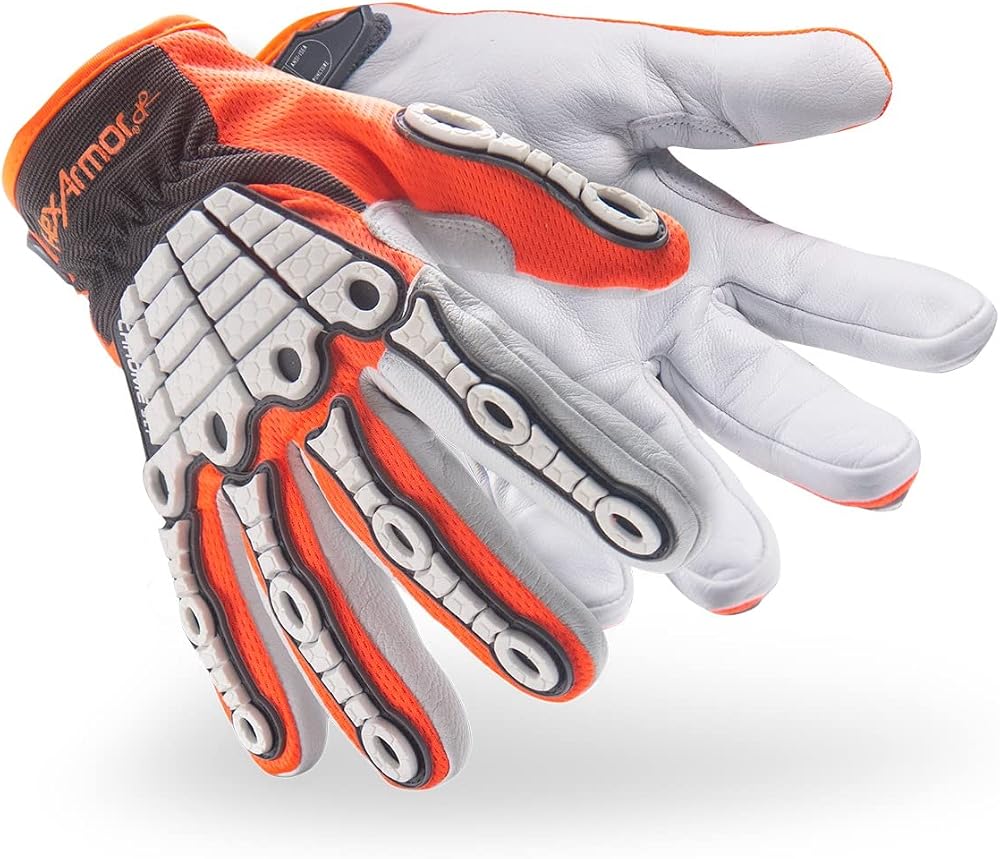
Standard: ANSI/ISEA 105 cut + ANSI/ISEA 138 impact · Palm: SuperFabric & leather · Back: TPR · Protects: palm + back of hand
Cut-resistant and impact-resistant gloves in one shell, the HexArmor Chrome SLT 4073 combines a SuperFabric-and-leather palm for laceration resistance with dorsal TPR for blunt-force protection. It is engineered for oil-and-gas and heavy industrial crews who face edges and impact in the same task. When the hazard assessment shows both blade and blunt-force risk, a true combo like this beats carrying two pairs. See it on the HexArmor Chrome SLT 4073 Cut & Impact-Resistant Work Gloves.
Pros
- Cut protection (palm) and impact TPR (back) together
- SuperFabric palm resists laceration and puncture
- Built for oil-and-gas and demolition crews
Cons
- Heavier and stiffer than a single-hazard glove
- Premium price
VIEW ON WC SAFETY →CHECK PRICE ON AMAZON →
HexArmor Rig Lizard 2095
Standard: ANSI/ISEA 105 cut + ANSI/ISEA 138 impact · Palm: PU-coated cut liner · Back: TPR · Protects: palm + back of hand
Cut-resistant and impact-resistant gloves on a lighter platform, the HexArmor Rig Lizard 2095 marries a PU-coated cut liner with dorsal TPR for a combo glove that stays flexible. It is the dexterous answer for crews who need both blade and blunt-force protection but still have to handle tools and fittings — a step down in bulk from the Chrome SLT while keeping dual-hazard coverage. See it on the HexArmor Rig Lizard 2095 Cut & Impact-Resistant PU Palm Gloves.
Pros
- Dual cut + impact protection in a flexible build
- PU-coated cut liner keeps dexterity
- Dorsal TPR for knuckle impact
Cons
- Lighter TPR than heavy demolition gloves
- Premium price for combo construction
VIEW ON WC SAFETY →CHECK PRICE ON AMAZON →
Cut vs impact gloves head-to-head
Hazard: laceration vs blunt force
This is the core split. Cut-resistant gloves answer a cutting hazard with an engineered yarn liner; impact-resistant gloves answer a blunt-force hazard with molded TPR. Neither substitutes for the other — an A9 cut glove still transmits a hammer blow to your knuckles, and a TPR impact glove with no cut liner still lets a blade through the palm. Always start from the OSHA 1910.138 hazard assessment.
Where you're protected: palm vs back of hand
Cut protection is a palm-and-finger property — that is where the liner sits and where gripping exposes you to edges. Impact protection is a back-of-hand property — that is where struck-by and pinch hazards land, and where the TPR guards go. A combo glove has to engineer both zones, which is why it is heavier and pricier.
Standards: ANSI/ISEA 105 vs ANSI/ISEA 138
The two ratings are independent. ANSI/ISEA 105 scores cut from A1 to A9 by grams-to-cut; ANSI/ISEA 138 scores impact from Level 1 to 3 by kilonewtons of transmitted force. A glove can carry one, the other, or both. Read both ratings on the box — a high cut level tells you nothing about impact, and vice versa.
Cost and dexterity
Cut gloves are generally lighter, more dexterous and cheaper–/pair); impact and combo gloves are bulkier and pricier–/pair) because of the TPR construction. If your hazard is purely cut, do not pay for impact bulk you will not use — and if it is purely impact, a thin cut glove will not save your knuckles.
What are cut-resistant and impact-resistant gloves?
Cut-resistant gloves are gloves whose palm-and-finger liner is knit from engineered cut-resistant fibers (HPPE, fiberglass, steel, or proprietary yarns like Ansell Intercept) and rated A1–A9 under ANSI/ISEA 105 for laceration resistance. Impact-resistant gloves are gloves fitted with molded thermoplastic-rubber (TPR) guards across the back of the hand and fingers, rated Level 1–3 under ANSI/ISEA 138 for the blunt force they transmit to the hand. The two are distinct protective systems addressing distinct hazards — cutting versus impact — and a growing number of work gloves integrate both into one shell. Neither rating implies the other, so a glove must be checked for each separately. For the standards themselves, see the ANSI/ISEA 138 reference and the EN 388 glove standard explainer.
Which gloves should you buy for your work?
Assembly, fabrication and small-parts handling
Light cut hazard, high dexterity need — an A2 to A3 cut glove like the PIP MaxiFlex Cut 34-8743 or Ansell HyFlex 11-561. CHECK PRICE ON AMAZON →
Glass, sheet-metal and stamping
Serious laceration risk — step up to an A5 cut glove like the MCR Safety CutPro A5. CHECK PRICE ON AMAZON →
Heavy equipment and pipe work
Struck-by and pinch hazards — an impact glove like the Ergodyne ProFlex 925F(x) or Mechanix Wear M-Pact. CHECK PRICE ON AMAZON →
Demolition and oil & gas
Both hazards at once — a combo glove like the HexArmor Chrome SLT 4073 or HexArmor Rig Lizard 2095. CHECK PRICE ON AMAZON →
Hi-vis mechanical and roadside work
Both hazards plus visibility — the dual-rated MCR Safety PD6901 Predator A9 with A9 cut and ANSI 138 impact. CHECK PRICE ON AMAZON →
How to choose between cut and impact gloves
Work the decision in order. 1. Run the hazard assessment required by OSHA 29 CFR 1910.138 — identify whether the real risk is cutting, impact, or both. 2. If it is cut, set the ANSI 105 level by edge sharpness using our how to choose by ANSI level guide and A4 vs A5 comparison. 3. If it is impact, set the ANSI 138 level (1–3) by the force of the struck-by hazard. 4. If it is both, choose a combo glove rated under both standards. 5. Get the fit right using our glove size chart — an oversized glove sacrifices both cut and impact protection.
Cut-resistant vs impact-resistant gloves: frequently asked questions
What's the difference between cut-resistant and impact-resistant gloves?
Cut-resistant gloves vs impact-resistant gloves protect against two different hazards. Cut-resistant gloves use an engineered yarn liner rated under ANSI/ISEA 105 (levels A1–A9) to stop blade and edge laceration on the palm and fingers. Impact-resistant gloves use molded thermoplastic-rubber (TPR) guards on the back of the hand, rated under ANSI/ISEA 138 (levels 1–3), to absorb blunt force. They are not interchangeable — one stops cutting, the other stops impact.
Can one glove be both cut-resistant and impact-resistant?
Yes. Many modern work gloves combine a cut-rated liner (ANSI/ISEA 105) on the palm with dorsal TPR (ANSI/ISEA 138) on the back of the hand — the HexArmor Chrome SLT 4073 and MCR Safety PD6901 Predator A9 are examples. For demolition, oil and gas, and heavy mechanical work where edges and impact coexist, a combo glove is usually the right call. Browse the impact-resistant gloves collection for dual-rated options.
Do I need cut gloves, impact gloves, or both?
It depends on your hazard assessment. Pure assembly, glass handling, or knife work is a cut hazard — choose a cut glove like the Ansell HyFlex 11-561. Heavy-equipment, pipe and demolition work where tools and parts strike the hand is an impact hazard — choose the Mechanix Wear M-Pact. When both risks are present, choose a combo glove. See how to choose by ANSI level.
What does ANSI/ISEA 105 measure, and what does ANSI/ISEA 138 measure?
ANSI/ISEA 105 measures cut (laceration) resistance, assigning levels A1 through A9 based on the grams of force needed to cut through the material on a TDM-100 test. ANSI/ISEA 138 measures back-of-hand impact protection, assigning Level 1, 2, or 3 based on the kilonewtons of force transmitted through the knuckle and finger guards. One is about cutting; the other is about blunt force. See the ANSI/ISEA 138 standard explainer.
Where on the hand does each type of glove protect?
Cut-resistant gloves protect the palm and fingers — that is where the cut liner sits and where most laceration happens during gripping and handling. Impact-resistant gloves protect the back of the hand and knuckles, where the molded TPR guards deflect struck-by and pinch hazards. This is why a true combo glove needs both a palm liner and a dorsal TPR shell.
Are impact-resistant gloves also cut-resistant?
Not automatically. A glove with dorsal TPR is rated under ANSI/ISEA 138 for impact, but unless it also carries an ANSI/ISEA 105 cut rating (A1–A9) on the palm, it offers no certified cut protection. The Mechanix Wear M-Pact is an impact glove without a cut liner; the MCR Safety PD6901 Predator A9 adds an A9 cut liner to its impact shell. Always check both ratings.
Which ANSI cut level do I need for sharp metal and glass?
Sharp sheet-metal and glass handling typically calls for ANSI/ISEA 105 Level A4 or A5 — the MCR Safety CutPro A5 is a common pick. Lighter assembly with nuisance cuts can use A2 like the PIP MaxiFlex Cut 34-8743. For the full mapping, see our A4 vs A5 comparison and best A5 cut-resistant gloves.
What are the ANSI/ISEA 138 impact levels?
ANSI/ISEA 138 has three levels based on the mean force transmitted through the glove's TPR guards: Level 1 (≤9 kN), Level 2 (≤6.5 kN), and Level 3 (≤4 kN) — lower transmitted force means better protection. Level 3 is the highest impact rating. See the best impact-resistant gloves guide for level-by-level picks.
Do cut gloves protect against punctures and needles too?
Cut resistance and puncture resistance are separate properties. A high cut level (A5–A9) helps with edges but does not guarantee needle or thorn puncture protection, which is tested differently. For needle and puncture hazards, look for a glove specifically rated for it, and review the EN 388 standard, which scores puncture separately from cut.
Are cut or impact gloves better for mechanics?
Mechanics often need both: cut protection against sharp edges and sheet metal, plus impact protection against struck-by and pinch hazards from tools and parts. A combo or dual-rated mechanics glove is ideal. See our best cut-resistant gloves for mechanics guide and the MCR Safety PD6901 Predator A9 for a both-in-one option.
Why are impact-resistant gloves usually more expensive?
Impact gloves carry molded TPR knuckle and finger guards, reinforced palms, and more complex construction than a simple coated cut glove, so they typically run– per pair versus– for many cut gloves. Combo cut-plus-impact gloves sit at the top of the range because they integrate both systems. Match the spend to the actual hazard rather than over-buying.
Does OSHA require cut or impact gloves?
OSHA 29 CFR 1910.138 requires employers to assess hand hazards and select appropriate protection — it does not name a specific glove or rating. Your hazard assessment determines whether you need cut resistance, impact resistance, or both. Document the assessment and match the ANSI/ISEA 105 cut level and ANSI/ISEA 138 impact level to the identified risks.
Can I wear cut gloves for impact work or impact gloves for cut work?
It is risky. A pure cut glove offers no certified back-of-hand impact protection, and a pure impact glove offers no certified palm cut protection. Using the wrong type leaves a real hazard unaddressed. If your task has both risks, use a dual-rated combo glove like the HexArmor Rig Lizard 2095 rather than substituting one single-hazard glove for the other.
Which is best for oil and gas or demolition work?
Oil-and-gas and demolition crews usually face both blade and blunt-force hazards, so a combo cut-and-impact glove is the standard choice — the HexArmor Chrome SLT 4073 is purpose-built for it. For heavy mechanical work with hi-vis needs, the MCR Safety PD6901 Predator A9 pairs A9 cut with ANSI 138 impact.
Where do I start if I'm new to glove selection?
Start with our cut-resistant gloves complete guide for the full overview, then read cut levels A1–A9 explained and the ANSI/ISEA 138 impact reference. Run a hazard assessment, decide whether your risk is cut, impact, or both, then browse the cut-resistant gloves and impact-resistant gloves collections.
How this comparison was researched. Picks were selected from products reviewed on WC Safety and evaluated against the governing standards and manufacturer documentation: (1) ANSI/ISEA 105, the standard for cut, puncture and abrasion resistance (cut levels A1–A9); (2) ANSI/ISEA 138-2019, the standard for back-of-hand impact resistance (levels 1–3); and (3) manufacturer specifications and box documentation (Ansell, Mechanix Wear, HexArmor, MCR Safety, PIP, Ergodyne). No first-person wear testing is claimed; guidance reflects standards and use-case analysis. Glove ANSI levels are stated only where the manufacturer publishes them.
Disclosure. WC Safety is a participant in the Amazon Services LLC Associates Program, an affiliate advertising program; as an Amazon Associate we earn from qualifying purchases via links on this page (tag wcsafety04-20). We accept no payment for placement — listings are independently selected. Prices and availability are accurate as of the date shown and subject to change. This guide is general information, not safety-compliance advice; verify glove suitability against your own documented hazard assessment.
Primary sources for this page
The wording behind this page sits in OSHA 29 CFR 1910.138, OSHA 29 CFR 1910.132, NIOSH Personal Protective Equipment.
Why trust this page?
Why trust this page? Every figure on it is taken from the published text of the standard or the manufacturer document named beside it, not from a secondary summary. WC Safety is an independent PPE review site: we hold no inventory and sell nothing directly, so there is no product we need this page to favour. Where sources disagree, the page says so and plans on the more conservative figure rather than picking one.
Methodology: how this page is maintained
Methodology. Figures are read from the primary source and re-checked whenever the underlying standard or a manufacturer document changes. No laboratory testing is performed for this page. Where a figure is not published, the page states that rather than estimating it, because a plausible invented number is more dangerous than an absent one.
Leave a comment